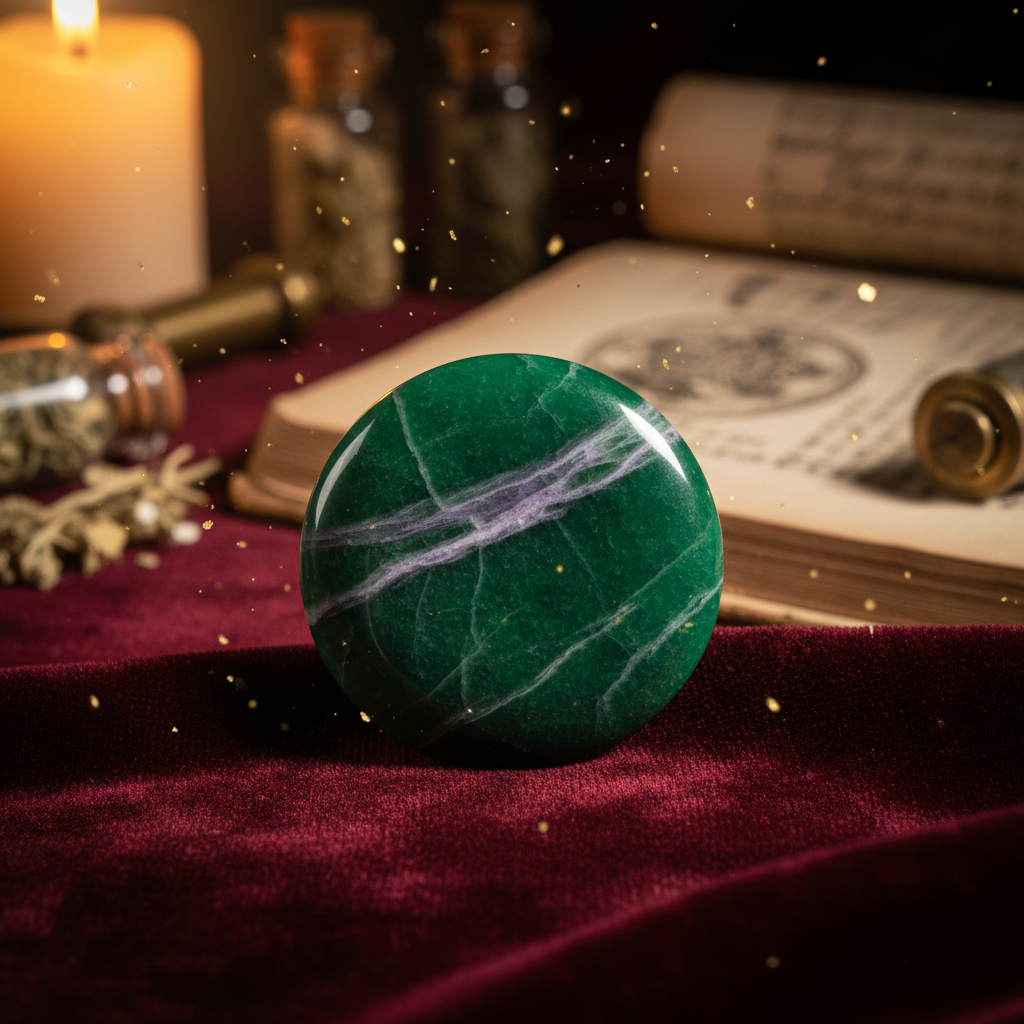
Jadeite
─── Why This Stone Matters ───
The Stone That Names the Brand
Jadeite (in Japanese: 翡翠 · Hisui) is the stone that gives this entire atelier its name. Stone Artistry HISUI is, literally, the artistry of jadeite.
Among the thirty-six power stones in the HISUI master collection, this one is the elder. The other stones arrive from many cultures — European mineral folklore, Vedic tradition, Chinese geomancy. Hisui comes from this land: from Itoigawa, from the Jōmon period, from five thousand years before written history.
No other stone on the planet carries an unbroken cultural lineage as long as Japanese jadeite. The same Hime River that the Jōmon walked to gather their first beads still pushes jade boulders onto the beaches today. The substance that crowned the first emperors crowns the current one. The line is unbroken.
✦ Three Distinctions ✦
1. Designated National Stone of Japan by the Japan Association of Mineralogical Sciences on 24 September 2016.
2. The material of the Yasakani no Magatama (八尺瓊勾玉), one of the Three Sacred Treasures of the Imperial Throne — passed from Amaterasu through every generation of emperors.
3. The world's oldest worked jade tradition — Jōmon-period beads from Itoigawa predate written history by over 3,000 years and the great Chinese jade traditions by more than three thousand years.
→ Read the full story: Why HISUI — The Sacred Jade of Japan
─── Mineralogy ───
Jadeite vs Nephrite — The Science Behind the Word "Jade"
The English word "jade" is commercial shorthand for two mineralogically distinct stones: jadeite and nephrite. Until the French mineralogist Alexis Damour formally separated them in 1863, even European jewellers conflated the two. The science has since matured, and the distinction is fundamental.
| Property | Jadeite (Hisui · 硬玉) | Nephrite (軟玉) |
|---|---|---|
| Mineral Group | Pyroxene | Amphibole |
| Composition | NaAlSi₂O₆ — sodium aluminium silicate | Ca₂(Mg,Fe)₅Si₈O₂₂(OH)₂ — calcium magnesium iron silicate |
| Mohs Hardness | 6.5 — 7 | 6 — 6.5 |
| Specific Gravity | 3.30 — 3.38 | 2.95 — 3.05 |
| Crystal Structure | Granular interlocking | Fibrous interlocking |
| Refractive Index | 1.660 — 1.680 | 1.600 — 1.640 |
| Lustre | Vitreous, brighter | Greasy, softer |
| Major Sources | Itoigawa (Japan), Myanmar, Guatemala, Russia | China (Hetian), Taiwan, Canada, Siberia, New Zealand |
| Global Rarity | Under 5% of commercial jade | Over 95% of commercial jade |
Jadeite is the rarer and more valued of the two. Its granular crystal structure gives it a glassier lustre that allows light to enter the stone more deeply, producing the inner glow that connoisseurs call shen — spirit. Nephrite, by contrast, has a fibrous structure that diffuses light into a softer, oilier sheen. Both have their devotees. Only jadeite is the National Stone of Japan.
Fracture Toughness — Tougher Than Steel
A common surprise: although jadeite ranks 6.5–7 on the Mohs scale of scratch hardness — below quartz and well below diamond — its fracture toughness (resistance to breaking under impact) is exceptional. The fibrous and interlocking crystal structure makes both jadeite and nephrite among the toughest natural materials known, surpassing even hardened steel by some measures. This is why Jōmon and Kofun jade artefacts survive intact across millennia: the stone refuses to break.
─── Colour ───
The Colour Spectrum of Itoigawa Jadeite
Most jadeite sources produce a single dominant colour. Myanmar yields the imperial green that dominates the contemporary jewellery trade. Guatemalan deposits produce blue-green and lavender. Russia produces pale white-green. Itoigawa, alone among the world's jadeite sources, produces the entire spectrum from a single river system.
The colour is determined by trace impurities crystallised into the jadeite matrix during its geological formation. Chromium produces the imperial green. Iron produces yellow-green and brown tones. Manganese produces the rare lavender. Graphite produces black. The geological conditions at Itoigawa — a high-pressure, low-temperature metamorphic environment along the ancient Pacific subduction zone — were uniquely suited to producing this breadth of variation.
─── Meaning ───
The Stone's Energy
Hisui carries the energy of sacred protection, eternity, symbolism, and the divine feminine. In Shinto tradition, jadeite is the stone the gods reached for first — the substance of offerings, the regalia of rulers, the bead worn against the heart.
"神を宿す石 — the stone that houses gods."
Hisui scores ★★★ on six of eight axes — the only stone in the HISUI master collection to do so. The strongest energy signature is, fittingly, the one that gives the brand its name.
The Four Pillars of Hisui Energy
- Benevolence (慈愛) — The kindness extended toward others and inward toward the self. The Japanese tradition associates jade with the heart that softens, the temper that quiets, the response that comes from compassion rather than reaction.
- Eternity (永遠) — Jadeite is among the toughest materials known. Its associations cluster around endurance, longevity, and the unbroken line — the same line that carries the regalia from Amaterasu to the present emperor.
- Comfort (癒し) — The cool green of the stone has been read since the Heian period as easing weariness, settling agitation, and grounding the body during illness. Heian-era nobles wore jadeite ornaments to ease fevers.
- The Sacred Feminine (神聖な女性性) — The magatama as foetus, as moon, as wave: the form of jade in Japan has always been bound to feminine cycles, fertility, and the goddess herself. Amaterasu, the sun goddess, holds the magatama in her hair in the foundational myth.
─── History ───
5,000 Years of Sacred Use
Japanese jade work begins in the Jōmon period (roughly 5,000–300 BCE) at Itoigawa, on the Sea of Japan coast in present-day Niigata Prefecture. Hunter-gatherers there were already drilling holes through jade boulders and stringing them into beads — at a date that places them among the world's earliest jade artisans, predating Chinese jade-working at its peak by over three thousand years.
By the Kofun period (~300–538 CE), the comma-shaped magatama bead had emerged as the signature form. Hundreds of jade magatama have been recovered from imperial tumuli, often paired with bronze mirrors and iron swords — the trinity that would become the regalia.
The mythological codification arrived in the Nara period: the Kojiki (712 CE) named the imperial bead as Yasakani no Magatama, gifted from the sun goddess Amaterasu to her grandson Ninigi, the divine ancestor of the imperial line. To this day, no emperor has ever ascended without it.
For nearly a thousand years after the Heian shift toward Buddhist iconography, the Itoigawa workshops fell silent and the location of Japan's jade source was forgotten. Then, in 1938, geologist Kawano Yoshitarō identified jadeite boulders in the Kotaki Stream — confirming that Japan had its own native source all along. Archaeological excavation followed, the Chōjagahara workshops were rediscovered, and the narrative of Japanese prehistory was rewritten.
On 24 September 2016, the Japan Association of Mineralogical Sciences formally designated jadeite — specifically the variety found at Itoigawa — as the National Stone of Japan. The five-thousand-year lineage met the modern era on that day.
The Chōjagahara Workshop Site
Three kilometres south of modern Itoigawa, the archaeological site of Chōjagahara preserves the remains of a Jōmon jade-working settlement. Excavations have uncovered drilling stones, unfinished beads, and the discard pile of artisans who lived 5,000 years ago. The technical sophistication is striking: holes were drilled with bow-driven flint and bamboo abrasives, achieved through patience that may have measured weeks per bead.
Trade routes from Chōjagahara reached as far north as Hokkaido and as far south as Kyushu — distances of over a thousand kilometres in an era before roads, before sails, before cargo animals. The stone moved through networks of exchange whose existence is unmistakable in the archaeological record.
─── Specifications ───
The Stone's Profile
─── Affinities ───
Tarot, Zodiac and Deity
Hisui's energy resonates with cards of fertility, balance, and the great work — and with both the Egyptian and Shinto deities of the sacred feminine.
─── Care ───
Caring for Hisui Jewellery
Jadeite is remarkably tough but still benefits from thoughtful care. The atelier recommends the following practices for bracelets and pendants:
- Clean with soft cloth — Wipe with a dry, lint-free cloth after wearing. Avoid ultrasonic cleaners, which can stress the matrix over time.
- Store separately — Although jadeite is harder than most everyday objects, store it apart from other jewellery to prevent surface marks from harder stones such as topaz or sapphire.
- Avoid harsh chemicals — Remove jadeite before swimming, applying perfume, or using cleaning products. Chlorine and ammonia can dull the surface.
- Lunar cleansing — In the Japanese witch tradition, hisui is rested under moonlight on the night of the full moon. This is folkloric rather than physical, but the practice deepens the bond between wearer and stone.
- Heat sensitivity — Extreme thermal shock can stress any natural stone. Remove hisui before saunas, hot baths, or prolonged sun exposure.
Frequently Asked Questions
What is jadeite?
Jadeite is a sodium aluminium silicate mineral (NaAlSi₂O₆) of the pyroxene group, with a Mohs hardness of 6.5–7. It is one of the two minerals commercially sold as jade — the other being nephrite. Jadeite is the rarer and more valued of the two. In Japan, jadeite is known as hisui (翡翠) and was designated the National Stone of Japan in 2016.
What is the difference between jadeite and nephrite?
Jadeite (硬玉) is a pyroxene with composition NaAlSi₂O₆, Mohs 6.5–7, denser at 3.30–3.38 g/cm³, with granular interlocking crystals producing a brighter, more vitreous lustre. Nephrite (軟玉) is an amphibole with composition Ca₂(Mg,Fe)₅Si₈O₂₂(OH)₂, Mohs 6–6.5, less dense at 2.95–3.05 g/cm³, with fibrous crystals producing a softer, oilier sheen. Jadeite is also significantly rarer, making up under 5% of the global jade trade. Japan's National Stone is specifically jadeite.
Why is jadeite called hisui in Japanese?
The name hisui (翡翠) was borrowed from the Chinese word for the kingfisher bird. The two kanji hi (翡) and sui (翠) originally meant the male and female kingfisher respectively. The bird's iridescent green-blue plumage shifts with the light, and the ancients named the stone after the bird because both share a green that lives and moves. The word arrived from China in the historical period, but Japanese hands had already been working the stone for over four thousand years before that — calling it simply tama (玉), the sacred stone.
Where is Itoigawa jadeite found?
Itoigawa jadeite is found in the Hime River and Kotaki Stream basin in Niigata Prefecture, Japan, on the Sea of Japan coast. River-tumbled jade boulders wash down from the Hida Mountains and onto the gravel beaches at the river mouth. The area was designated a UNESCO Global Geopark in 2009 in part because of its jade. The geological formation is over 500 million years old and produces the widest colour spectrum of any jadeite source in the world, including the rare lavender variety.
What is the Yasakani no Magatama?
The Yasakani no Magatama (八尺瓊勾玉) is the jade comma-shaped bead that constitutes one of the Three Sacred Treasures (Sanshu no Jingi) of the Japanese Imperial Throne. According to myth, it was brought to earth by the grandson of the sun goddess Amaterasu and has been passed down through every emperor since. It is the only one of the three treasures that resides with the emperor himself at the Imperial Palace in Tokyo, rather than at a distant shrine. Its material is jadeite — almost certainly from the Itoigawa source.
What does the name HISUI mean for the brand?
Stone Artistry HISUI takes its name directly from the Japanese word for jadeite. The atelier, based in Miyagi Prefecture, crafts dark-romantic crystal bracelets and the Noctéline Oracle tarot. The name invokes the 5,000-year tradition of treating stones as living things — as the substance the Japanese gods reached for first. The brand carries the lineage of Itoigawa jade into contemporary witch-aesthetic jewellery.
Can jadeite be worn as a daily amulet?
Yes. Jadeite has been worn as a daily amulet stone (omamori) in Japan since the Jōmon era, making it one of the world's oldest continuously worn amulet materials. Its exceptional fracture toughness — among the highest of any natural stone — makes it well suited to daily wear. The traditional forms are the magatama pendant on a silk cord, the bracelet, and the ring. The four energies most associated with hisui are benevolence, eternity, symbolism, and the sacred feminine.